
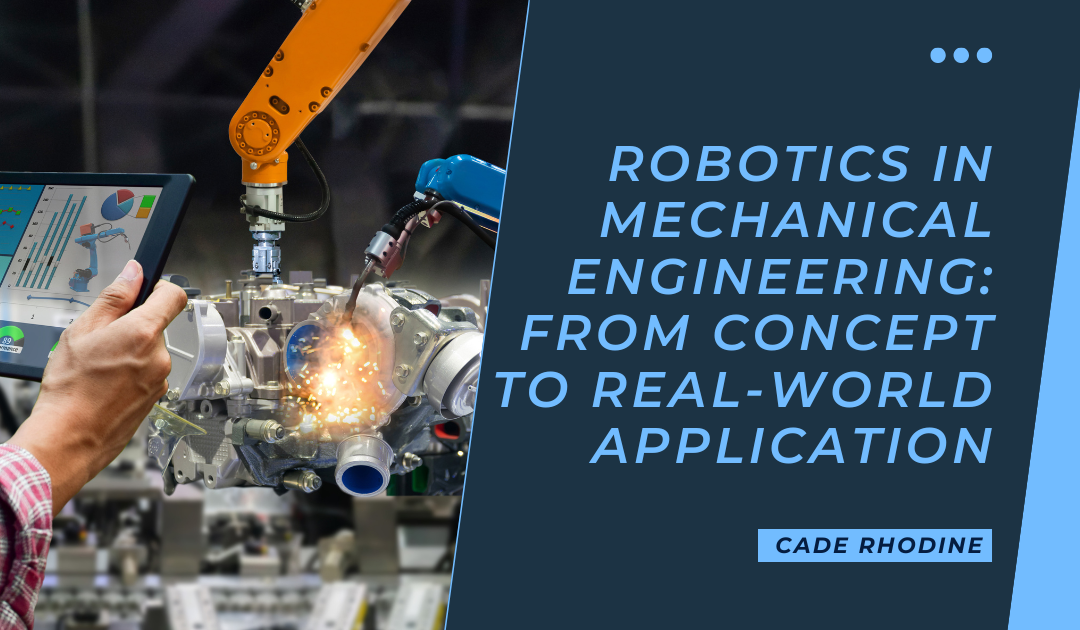
The field of mechanical engineering has long been the bedrock of innovation, and in recent decades, it has found a powerful ally in robotics. As industries strive for efficiency, precision, and automation, the role of robotics in mechanical engineering has grown from a niche application to a transformative force. The journey from concept to real-world implementation reveals how the fusion of mechanical systems, control algorithms, and intelligent design is reshaping industries and the way we live and work.
Robotics in mechanical engineering begins at the conceptual stage, where engineers imagine and design machines capable of performing specific tasks. These tasks can range from repetitive actions in manufacturing to complex, delicate operations in healthcare or aerospace. Mechanical engineers focus on the structure, motion, energy transfer, and material properties of robotic systems. Every robot must be precisely engineered for durability, flexibility, and performance within its intended environment.
Computer-aided design (CAD) tools are essential in this phase, enabling engineers to model robots in 3D and simulate their functions. These simulations allow for early testing of joint movement, force distribution, thermal resistance, and other mechanical properties before a prototype is built. With advancements in software, engineers can optimize designs, reduce material waste, and predict potential issues, saving time and resources.
Once the design phase is complete, the prototyping stage bridges theory with practice. Engineers build physical versions of their robotic systems, often using advanced manufacturing techniques such as 3D printing, CNC machining, and laser cutting. During this stage, precise tolerances, material compatibility, and integration of actuators and sensors are critical. Mechanical engineers must ensure that each component operates in harmony with others and withstands real-world conditions, such as vibration, impact, and wear.
Robots are only as effective as their ability to move, sense, and respond. This brings in the importance of kinematics and dynamics—core aspects of mechanical engineering. Kinematics involves the motion of robotic limbs and joints, while dynamics explores the forces and torques acting upon them. These principles allow robots to execute smooth, coordinated movements and adjust to external stimuli in real time. For example, an industrial robot arm placing microchips must apply the exact amount of pressure with micrometer-level precision, a feat only achievable through refined mechanical design and motion control.
The real-world applications of robotics engineered through these mechanical principles are vast and varied. In manufacturing, robotic arms streamline assembly lines, enhancing productivity and reducing human error. Automotive companies use robots for tasks like welding, painting, and quality inspection. In logistics, autonomous mobile robots transport goods across warehouses with precision and speed.
In healthcare, robotic systems like surgical robots enable minimally invasive procedures with greater accuracy and reduced recovery times. Prosthetic limbs equipped with robotic components allow amputees to regain motion and perform everyday tasks with improved functionality. These advancements would not be possible without deep mechanical understanding of the human body’s biomechanics, motion control, and material behavior.
The aerospace industry also benefits significantly from robotic systems. Mechanical engineers design robotic tools for spacecraft maintenance, satellite servicing, and planetary exploration. These robots must withstand extreme temperatures, radiation, and vacuum conditions, demanding rigorous mechanical analysis and material testing. Mars rovers, for instance, are engineered to navigate uneven terrain, collect samples, and relay data—all while being millions of kilometers away from Earth.
Emerging technologies are pushing the boundaries of what robotics can achieve. Soft robotics, inspired by biological systems, are being developed with flexible materials that allow for more natural movement and safer human-robot interactions. These robots are particularly valuable in medical and service-oriented applications, where gentleness and adaptability are essential.
Collaborative robots, or cobots, are another innovation that stems from advanced mechanical engineering. Unlike traditional robots that work in isolation, cobots are designed to work alongside humans safely. They use force sensors, lightweight materials, and intelligent design to interact with their environment without posing risks to nearby workers.
Despite these advancements, challenges remain. Designing robots that are energy-efficient, durable, and cost-effective requires continuous innovation. Mechanical engineers must consider lifecycle performance, ease of maintenance, and sustainability. Additionally, as robotics become more integrated with artificial intelligence and IoT, engineers must work across disciplines to create cohesive, smart systems.
In conclusion, robotics in mechanical engineering represents the intersection of imagination and precision. From the drafting board to deployment on factory floors or in operating rooms, the journey of robotic systems is guided by the principles and ingenuity of mechanical engineers. As technology continues to evolve, the collaboration between mechanical engineering and robotics promises even greater contributions to society, unlocking possibilities across every major industry.